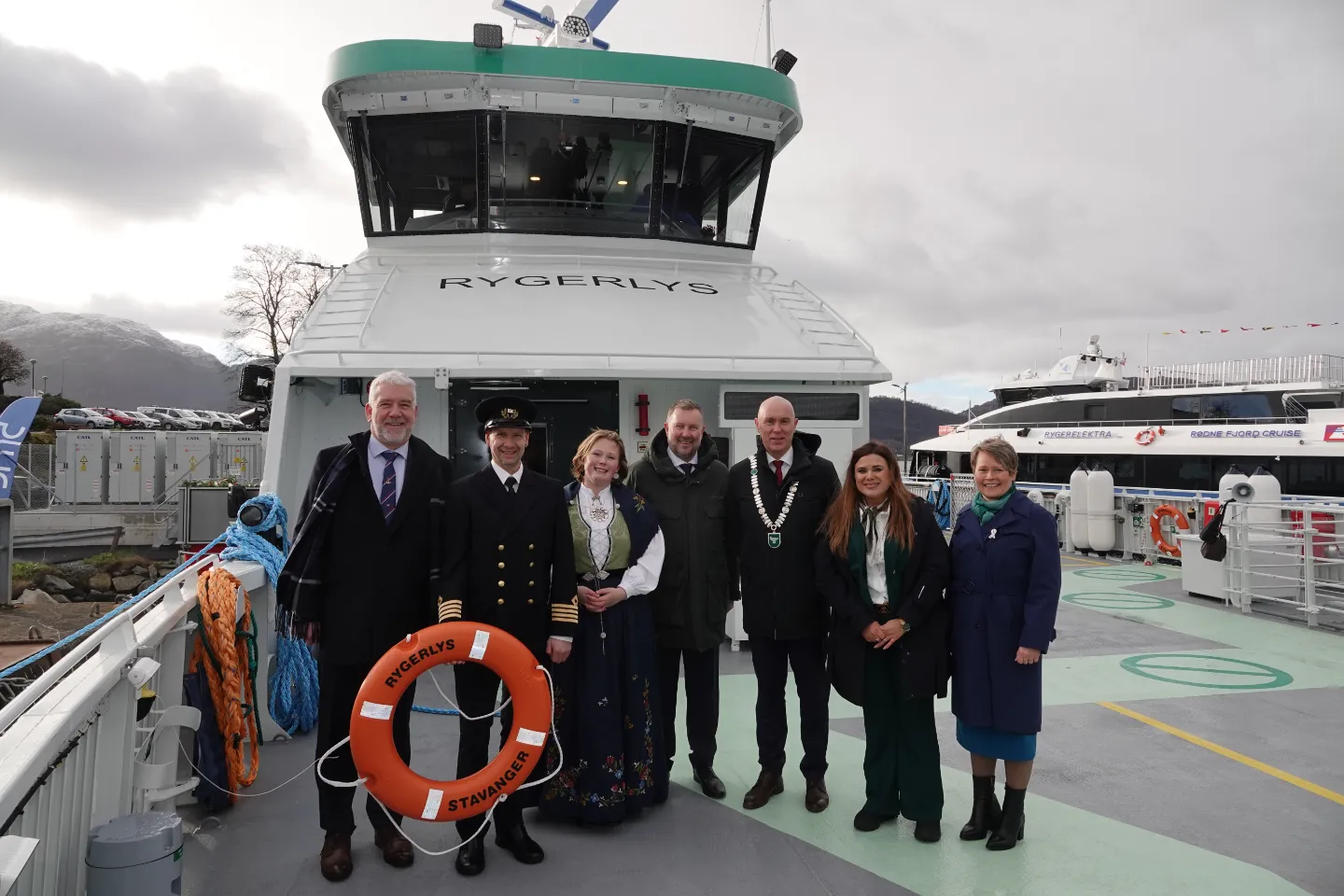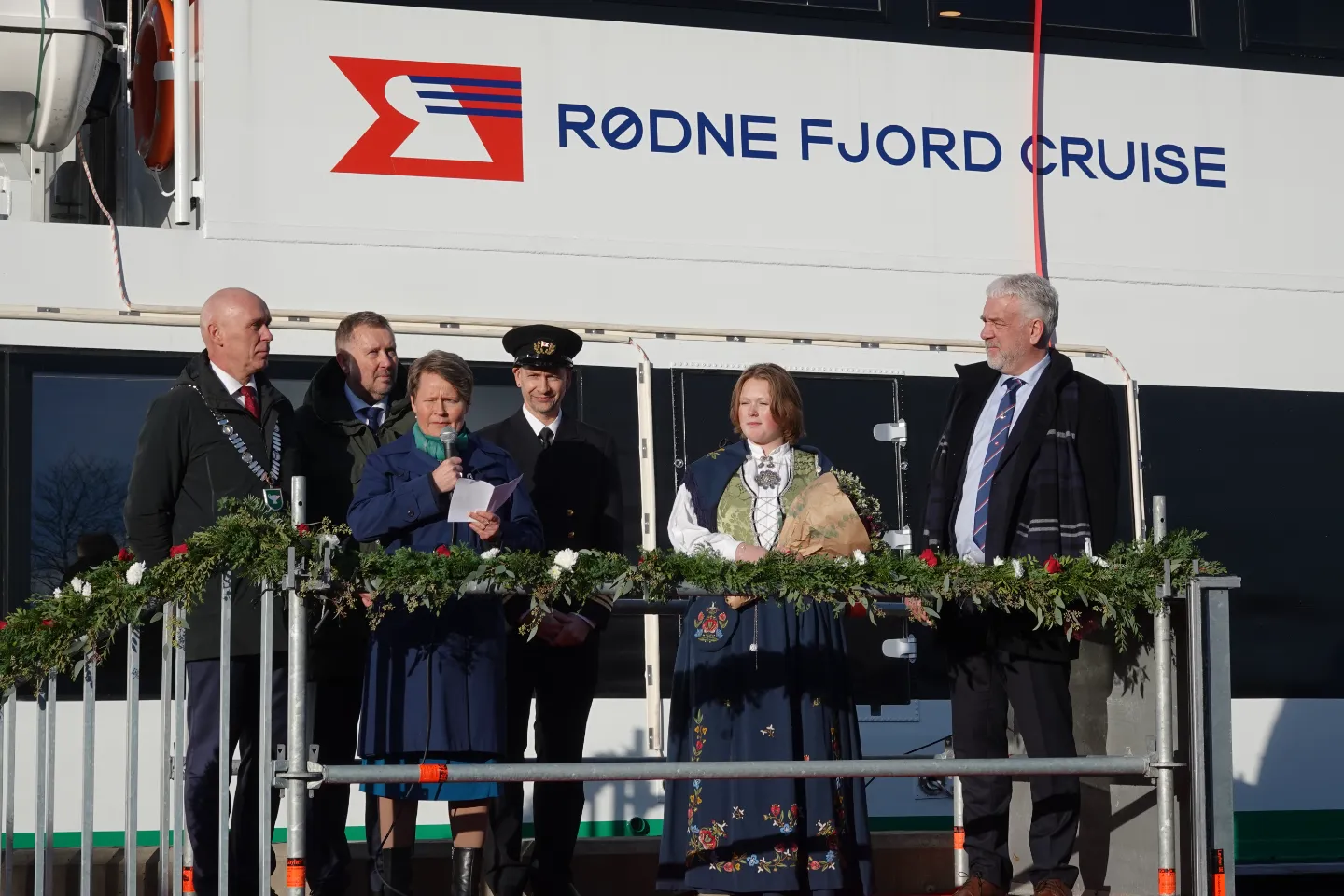
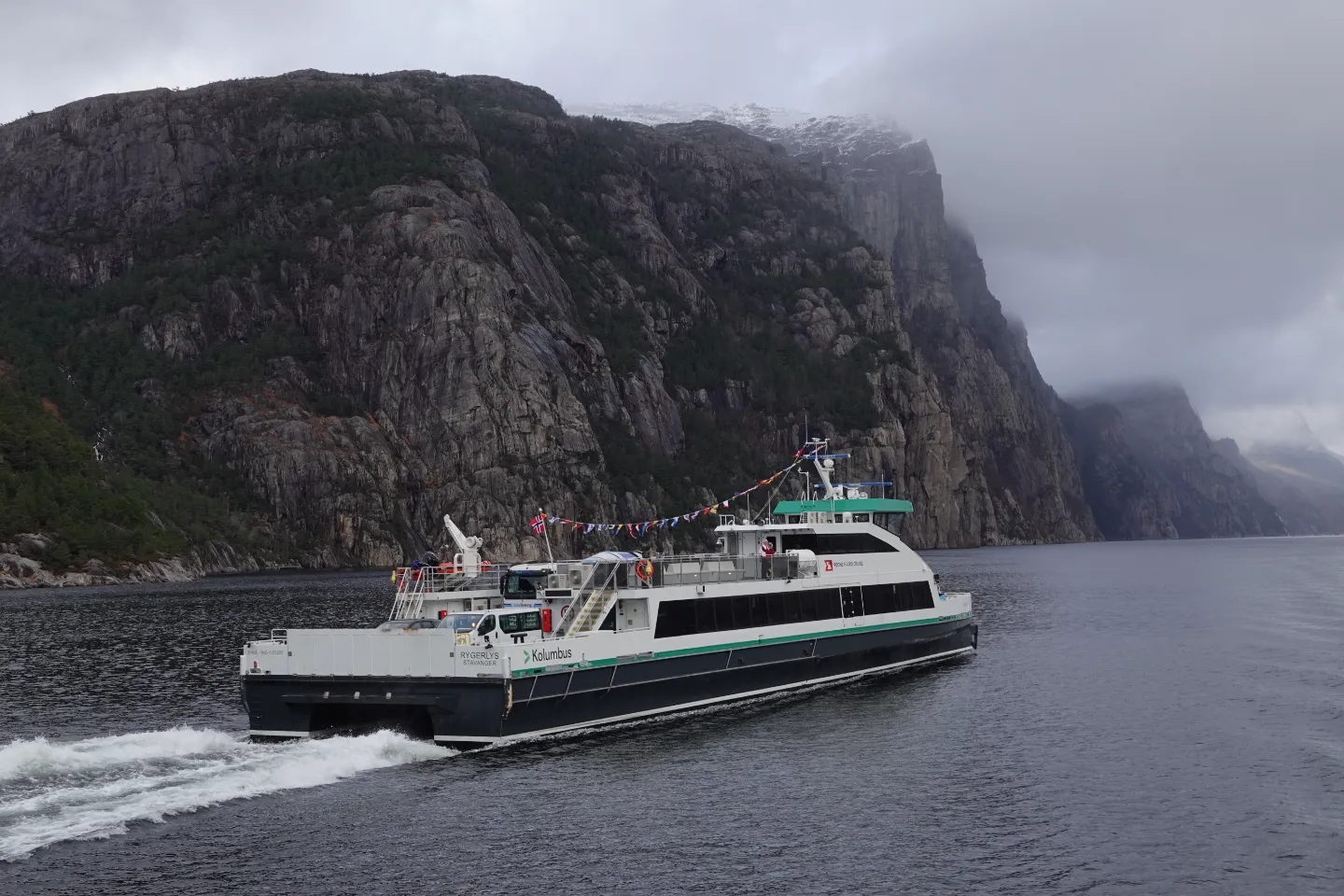
The naming of the fully electric MS Rygerlys and the opening of the Forsand charging facility on 12. November mark a new chapter for battery electric transport in Lysefjord. Several Maritime CleanTech partners have key roles in the collaboration, bringing the vessel, charging infrastructure and everyday operations together.
The combi catamaran owned and operated by Rødne on contract with Kolumbus will carry passengers, vehicles and cargo between Lauvvik and Lysebotn in Rogaland, offering residents and visitors comfortable battery-electric transport.
“This is a story about how local demand and ambitious maritime clusters step by step build industrial expertise needed to mature and scale the uptake of battery-powered vessels. Each new delivery gives shipowners, shipyards and technology suppliers the essential opportunity to refine their solutions and gain experience, also to be applied to next generation vessels and penetrate new markets,” says Øystein Huglen, Head of Technology and Innovation at Maritime CleanTech.
From Norwegian fjords to international markets
Norwegian fjords have always been testing grounds for world leading innovation, and lately this includes battery powered ships. MF Ampere demonstrated battery-electric operation in regular ferry services from 2015. In 2020 Rygerelektra started battery-electric tourism on Lysefjord and in 2022, Medstraum extended that potential to high-speed public passenger transport through the EU-supported TrAM project, bringing hull design, weight, propulsion and electrical systems to next level of energy optimization.
Experience gained in the Norwegian market has helped suppliers scale battery-electric shipping from local ferry routes to e.g. the world’s largest battery-electric fast-ferry, the 130-metre China Zorrilla, showing how expertise developed in Norwegian waters can support much larger international projects.
A report made by Maritime CleanTech and Menon Economics, shows that Norwegian suppliers already export several billion kroner worth of maritime electrification technology annually. This industry has grown out of a strong domestic market built in Norwegian fjords over the past 10–15 years.
“The exemplary willingness to collaborate, share risk and pursue new technologies is essential to succeed through the ongoing maritime transition, and remain in front of competition”, Huglen adds.
Globally, batteries and electric propulsion is picking up in numbers and across more vessel types traditionally powered by diesel. Alongside benefits on greenhouse gas emissions, exhaust, noise and vibrations, battery-electric operations are also becoming increasingly cost-effective and attractive investments.
Connecting vessel, charging and operations
Battery-electric transport is not only dependent on the vessel, as availability of electrical power supply, grid and reliable charging facilities have often been the most challenging part. The successful commissioning of the Forsand charging facility, including battery storage system and the world’s first vessel application of the MCS charging standard, is therefore as important to this milestone as the vessel itself.
The value chain includes Kolumbus as client, Rødne as owner and operator of the vessel and Plug as provider of the charging facility. The vessel is built by Oma baatbyggeri at Stord and the deliveries are supported by a range of Norwegian suppliers like Fjellstrand Yard, Servogear, Brunvoll and Teca.
"Rødne come with several successful years of battery-electric operations. MS Rygerlys and the Forsand charging system have already been extensively tested, giving us confidence in reliable operations. We are proud to introduce MS Rygerlys to our Lysefjord operations, and to offer our passengers the added comfort and reduced emissions this vessel represents" says Lars Rødne, CEO in Rødne Fjord Cruise. “This would not have been possible without the strong collaborative efforts from all contributing partners in the project. Together, our industry cluster continue to take a leading role in the maritime green transition”