Maritime CleanTech has submitted its response to Enova's public consultation on a new funding scheme for carbon capture and permanent CO₂ storage, calling for stronger support to bring onboard carbon capture from pilot projects to commercial deployment.
The proposed scheme is an important step towards building Norwegian carbon capture and storage (CCS) value chains. However, as currently designed, it is limited to emissions from stationary industrial facilities, waste incineration, and energy production, meaning that onboard carbon capture and storage (OCCS) for ships falls outside the scope.
Scaling requires more than technology
Maritime CleanTech supports Enova's ambition to accelerate CCS but argues that the maritime sector faces a different set of barriers than land-based industry.
While pilot funding for onboard capture technology already exists, today's support schemes do not provide sufficient incentives to move from demonstration projects to commercial deployment. The biggest challenge is no longer proving that onboard capture works but rather creating a complete value chain that enables captured CO₂ to be received, processed and delivered for permanent geological storage or utilization.
Without this infrastructure, onboard carbon capture risks remaining a promising pilot technology rather than becoming a scalable climate solution.
A dedicated maritime category
In its consultation response, Maritime CleanTech recommends that Enova either:
- include onboard carbon capture as a dedicated category within the new CCS scheme, or
- clearly explain how CO₂ captured onboard ships will be supported through future CCS funding programmes.
We also recommend establishing a dedicated maritime project category with evaluation criteria tailored to shipping. Maritime OCCS projects typically involve smaller CO₂ volumes, different operational profiles and additional technical requirements compared with large industrial capture plants, making direct competition on cost per tonne of CO₂ stored difficult.
Building complete maritime CCS value chains
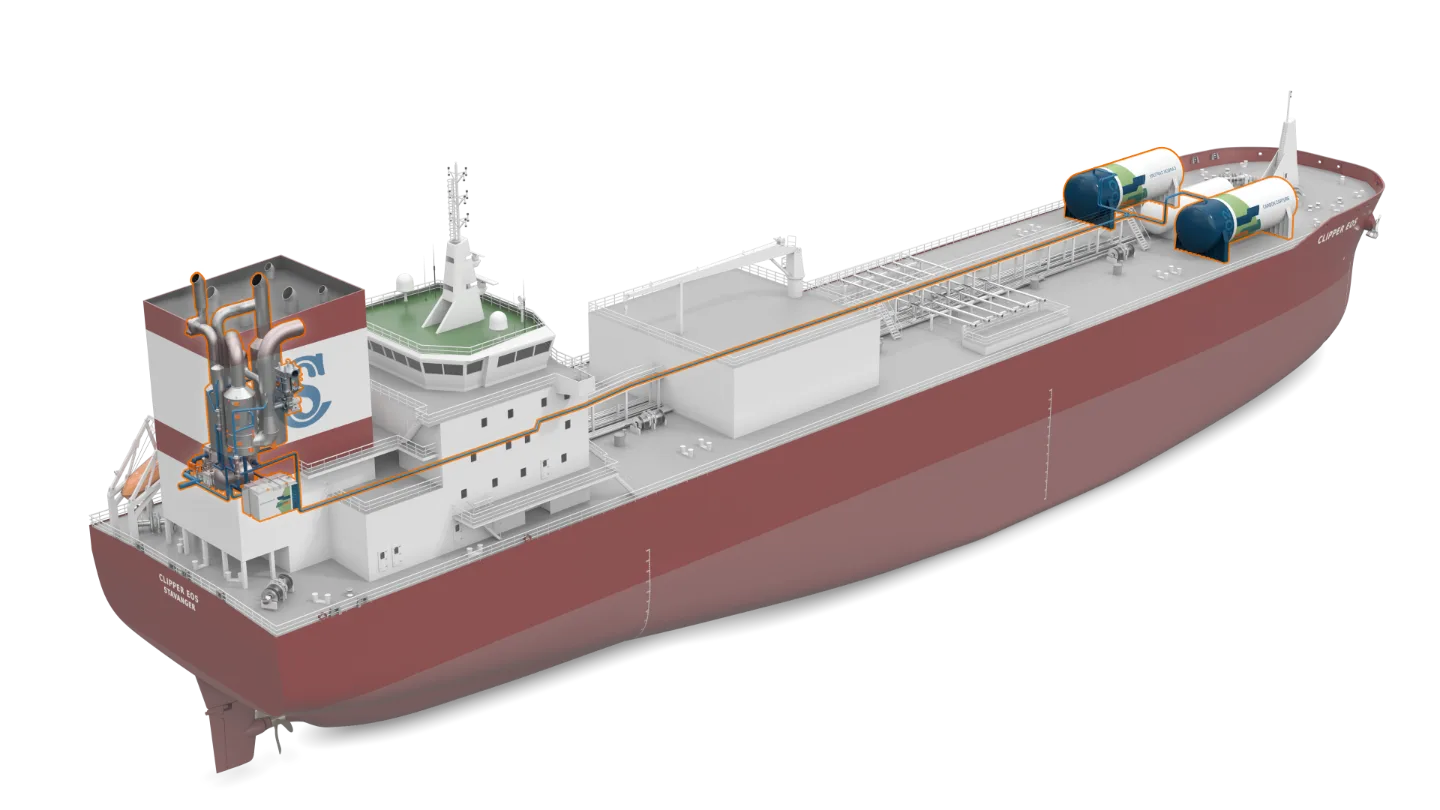
Maritime CleanTech stresses that future funding should support complete maritime CCS value chains rather than isolated technology demonstrations. This includes onboard capture systems, reception facilities, intermediate storage, CO₂ conditioning, documentation and verification, and access to permanent geological storage.
The organisation also highlights the need to better coordinate Enova's different funding programmes, including the new support scheme for CO₂ reception terminals, to ensure that supply and demand develop in parallel.
From pilot to commercial deployment
The consultation response concludes that onboard carbon capture has the potential to become an important decarbonisation solution for shipping segments where electrification or alternative fuels are difficult to implement.
To unlock that potential, policy support must evolve from funding isolated pilot installations to enabling commercially viable maritime CCS ecosystems.
"The key challenge is no longer demonstrating the technology onboard. It is establishing complete and commercially viable value chains that connect onboard capture with permanent CO₂ storage."
says Analysis and Policy Manager, Reber Iversen.
Read the full response here (in Norwegian).